
FDIC Proposes Parity Rule Extending Preemption to Interstate State-Chartered Banks
As national bank preemption continues to develop and more applicants choose national bank (including national trust bank) charters, the FDIC has proposed a reinterpretation of federal law that would give state-chartered FDIC-insured banks (state banks) more equal footing with national banks when providing non-branch services outside of their charter states and better reflect modern practices in light of the migration of banking activity away from branches to non-branch channels. While the new rule wouldn't give state banks complete parity with national banks—it can't—the FDIC's proposed rule would narrow the gap.
By expanding a conflicts-of-law regulatory provision, the FDIC seeks to leverage federal preemption while sidestepping tricky issues of making a preemption determination itself. This approach works because the OCC has been actively promoting and developing national bank preemption and national bank powers under its own expansive statutory authority. If the FDIC's strategy works, state banks stand to benefit from these OCC interpretations. That's good news for them and the many fintechs, tech companies, and others that partner or work with them. Courts and critics, however, may look through the conflicts-of-law framing to the substance: federal preemption of state law—often fertile ground for a fight.
Comments on the proposed rule are due November 6, 2026.
Key Takeaways
- The proposal would expand national bank preemption benefits to state banks operating in host states without requiring them to establish a physical branch in the host state—modernizing the regulatory framework to reflect current financial services practices.
- The proposal would benefit all state banks, including Federal Reserve member banks, nonmember banks, as well as industrial loan companies—making it particularly attractive for these banks as well as fintechs seeking charter flexibility or looking to partner with various kinds of banks in different states.
- But the proposal wouldn't extend parity to uninsured state-chartered institutions (like the many state-chartered trust companies pursued by digital asset companies), non-bank affiliates of state banks, or Madden preemption issues related to state usury caps. It would leave national trust banks as the only uninsured non-depository institutions that enjoy full national bank preemption.
Background
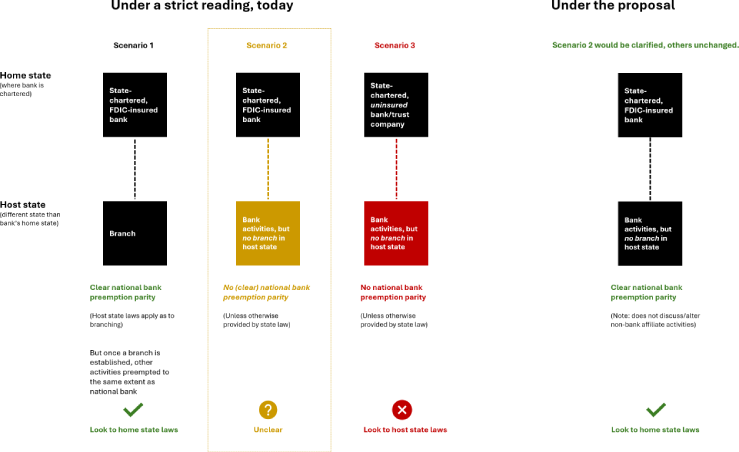
The FDIC has proposed a reinterpretation of section 24(j) of the Federal Deposit Insurance Act (FDI Act). The statute expressly preempts host state laws when a state bank operates in that state through a branch, just like a national bank with an interstate branch. The statute and current regulation don't say anything about operating in a host state by using the many non-branch options that are available and common in providing modern financial services.
What Would Change
FDIC regulations currently track the statute and state that the laws of a host state apply to any branch of an out-of-state state bank in that host state to the same extent as the host state's laws apply to a branch of an out-of-state national bank in that host state. Where host state law is inapplicable to these branches, home state law applies. This is the case with the recent Illinois Interchange Fee Prohibition Act (IFPA), which would have limited interchange fees that out-of-state banks could collect in Illinois.
The proposed regulation would instead provide that "the laws of a host state … apply to any branch in the host State of, or any services provided in the host State" by an out-of-state state bank to the same extent as these laws apply to "a branch in the host state of, or any services provided in the host State by, an out-of-State national bank." Thus, home state law would apply to non-branch activities too, such as the collection of interchange fees.
Rationale for the Proposal
Under a strict reading of the statute and the FDIC's current regulations, a state bank that operates in a host state already gets the same preemption of host state law that a national bank enjoys, provided it has a branch there. The proposal would extend this preemption parity, even if the out-of-state bank doesn't have a branch in the host state. Requiring the formality of establishing a branch in a host state just to get the benefit of more general preemption isn't a compelling policy argument, good use of agency resources, or even the proper use of interstate branches. The FDIC's proposal would fix that.
Entities the Proposal Would and Wouldn't Apply To
The proposal would apply to all state-chartered banks that are FDIC-insured (i.e., state banks). That includes state banks that are members of the Federal Reserve System and those that are not, and industrial loan companies (also called ILCs or industrial banks). Fintechs that seek ILC charters to accept certain kinds of FDIC-insured deposits and make loans while avoiding becoming bank holding companies with associated restrictions on commercial activities, would stand to gain similar benefits to national banks, while avoiding Federal Reserve regulation and restrictions.
The proposal would not extend parity to state-chartered, uninsured institutions such as many state-chartered trust companies that digital asset companies have pursued in recent years, as well as uninsured, "skinny," or other similar bank charters, such as Georgia's merchant acquirer limited purpose bank charter or Connecticut's uninsured bank charter. National trust banks still are the only uninsured non-depository institutions that enjoy the full benefits of national bank preemption because they are statutorily derived from full national banks. Under a pro-chartering policy at the OCC, the national trust bank option remains a strong charter choice for many in payments that do not want to accept deposits or lend.
The proposed rule also wouldn't apply to non-bank affiliates of state banks and it wouldn't resolve Madden preemption issues on state usury caps involving non-bank subsidiaries of banks.
Activities/Issues the Proposal Would and Wouldn't Extend To
The FDIC's choice-of-law provision would pack a lot of punch. Below is a sampling of various activities and state laws that would be preempted from applying to state banks, based on national bank preemption.
|
Preemption for* |
No preemption for** |
|
State licensing, authorization, approvals, registration requirements and other similar restrictions concerning lending or deposits |
Interest rates and lending While the FDIC's reinterpretation of section 24(j) expressly does not touch section 27 of the FDI Act, it would codify a bank-centric view that is consistent with other FDIC positions that look to home state law for many permissible activities |
|
Certain consumer laws regulating disclosures and advertising content rules |
Contract law |
|
Requirements to pay interest on escrow funds |
Criminal law |
|
Non-interest bank fee prohibitions (e.g., interchange) |
Tort law |
|
Payments transaction data limits |
Property, taxation, and |
|
Debt-collection rights |
* Assuming preemption is upheld in court challenges.
** The OCC has clarified in its regulations that many of these state law issues are not preempted.
The Proposal's Strengths and What Critics are Likely to Target
The statute clearly speaks of branches. The FDIC would either be reading that word out or expanding the meaning of "branch" to essentially include "non-branch" activities. The idea that an out-of-state bank need only establish a branch to get the benefit of statutory preemption nevertheless gives the FDIC some cover. A strict reading of the current law forces banks to adopt a model it has moved away from, which doesn't make sense as a policy. And forcing banks to establish branches simply to get broader preemption doesn't reflect branches' true function.
While notable groups such as the Conference of State Bank Supervisors have publicly come out in support of the proposed rule, opposition from some states or consumer groups is likely and may ultimately be the subject of judicial review.
The FDIC knows that and has sought to base its interpretation on the structure and legislative purpose of section 24(j). The FDIC also asserts in the preamble to the proposed rule its broad and unique interpretative powers granted by the FDI Act in 12 U.S.C. 1819(a)(Tenth) and 1820(g), under which the FDIC may "prescribe … rules and regulations as it may deem necessary to carry out the provisions of this chapter or of any other law which it has the responsibility of administering or enforcing" and "by regulation [may] define terms as necessary to carry out this chapter." Post-Loper Bright, judicial review and possible restrictions on federal banking agencies' interpretive powers, as defined in statute, have become inevitable.
Our Take
The FDIC's proposal seeks to bring more parity to the dual banking system by updating obsolete and likely unintended narrow language in statutes from a bygone era. If it succeeds, state banks will benefit greatly from OCC preemption determinations that survive. With the development of federal banking law through the GENIUS Act and the OCC's new role under it, as well as market changes more broadly, we expect OCC preemption to develop in important ways to enhance a modern and globally competitive regulatory framework.
If the FDIC could apply this nimble and refreshing approach to other sections of the FDI Act—notably brokered deposits under section 29—banks, their partners, and the customers they serve would benefit from more modern and rational regulatory solutions that work in practice, not just theory.
+++
Max Bonici and Steve Gannon are partners in DWT's Washington, D.C., office, and Eric Goldberg is a partner in the firm's Seattle office. For questions or more insights, please reach out to the authors or another member of our financial services team. To stay informed, sign up for our alerts.