
Trust Issues: July 2026
In This Issue
- A Wave of Artificial Intelligence Bills Await New York Governor's Signature
- President Trump Issues Two Executive Orders on Quantum Computing
- Court Allows ECPA Claim Premised on DOJ Bulk Data Rule Violation to Proceed
- CISA Town Halls Point to Potentially Significant Changes to CIRCIA Notification Rules
- Five Eyes to Corporate Leaders: Act Now to Address AI Cyber Risks
- FCC's Breach Reporting Rules: Updates on Ohio Telecom Ass'n v. FCC
A Wave of Artificial Intelligence Bills Await New York Governor's Signature
AI bills are surging in state legislatures. While the vast majority ultimately fail, the New York State Legislature passed six bills that now await the governor's signature. These bills are not yet, and may never be, laws. But they are important to be aware of, since they illustrate the types of state AI bills that have a better chance of passage and enactment.
Unlike various comprehensive AI governance bills that failed in Louisiana, New Hampshire, Washington, Utah, and Tennessee, the New York bills are tailored to address specific AI risks or discrete use cases in defined industry scenarios. Many of these bills would align New York with laws that have already been passed in other states, such as California. Other bills like New York's "FAIR News Act," would go beyond what other states have enacted.
Prohibition on Unsafe AI Companion Features for Minors (S9051B)
This bill would prohibit operators of certain AI "companion" systems from providing unsafe features to minors. Covered AI companions are defined as generative AI systems with natural language interfaces that provide ongoing, adaptive responses to users, such as conversational chatbot-style systems designed to simulate companionship.
The legislation would require operators to use age‑assurance methods to verify whether a user is a covered minor, subsequently barring minors from interacting with AI companions that use features likely to mislead or psychologically manipulate them. Prohibited features include outputs that imply the AI is a real person or emotional being, simulate personal or authority relationships, engage in flattery or emotional probing unrelated to a user's prompt, encourage secrecy or isolation, promote destructive behaviors such as self-harm or substance abuse, or facilitate engaging in sexually explicit conduct or produce child sexual abuse material.
The New York attorney general would be able to enforce the law through civil actions seeking injunctions, restitution, disgorgement of profits, and civil penalties of up to $25,000 per violation. If signed, the law would take effect January 1, 2027. S9051B would build on New York's existing Artificial Intelligence Companion Models Act (Article 47).
Prohibition on Chatbot Toys (S9408A)
This bill would prohibit the manufacture, sale, distribution, or offering for sale of "chatbot toys" in New York. A chatbot toy is defined as a children's toy that contains or integrates an AI companion capable of conversational interaction with users. The law is intended to prevent children from interacting with AI-driven toys that could simulate relationships or collect information in ways that may raise safety or privacy concerns.
The New York attorney general would have enforcement authority and could seek injunctive relief and civil penalties of up to $15,000 per day for each violation. Courts could issue injunctions without requiring proof that any individual was harmed. If enacted, the law would take effect 90 days after signing and would automatically expire five years after its effective date.
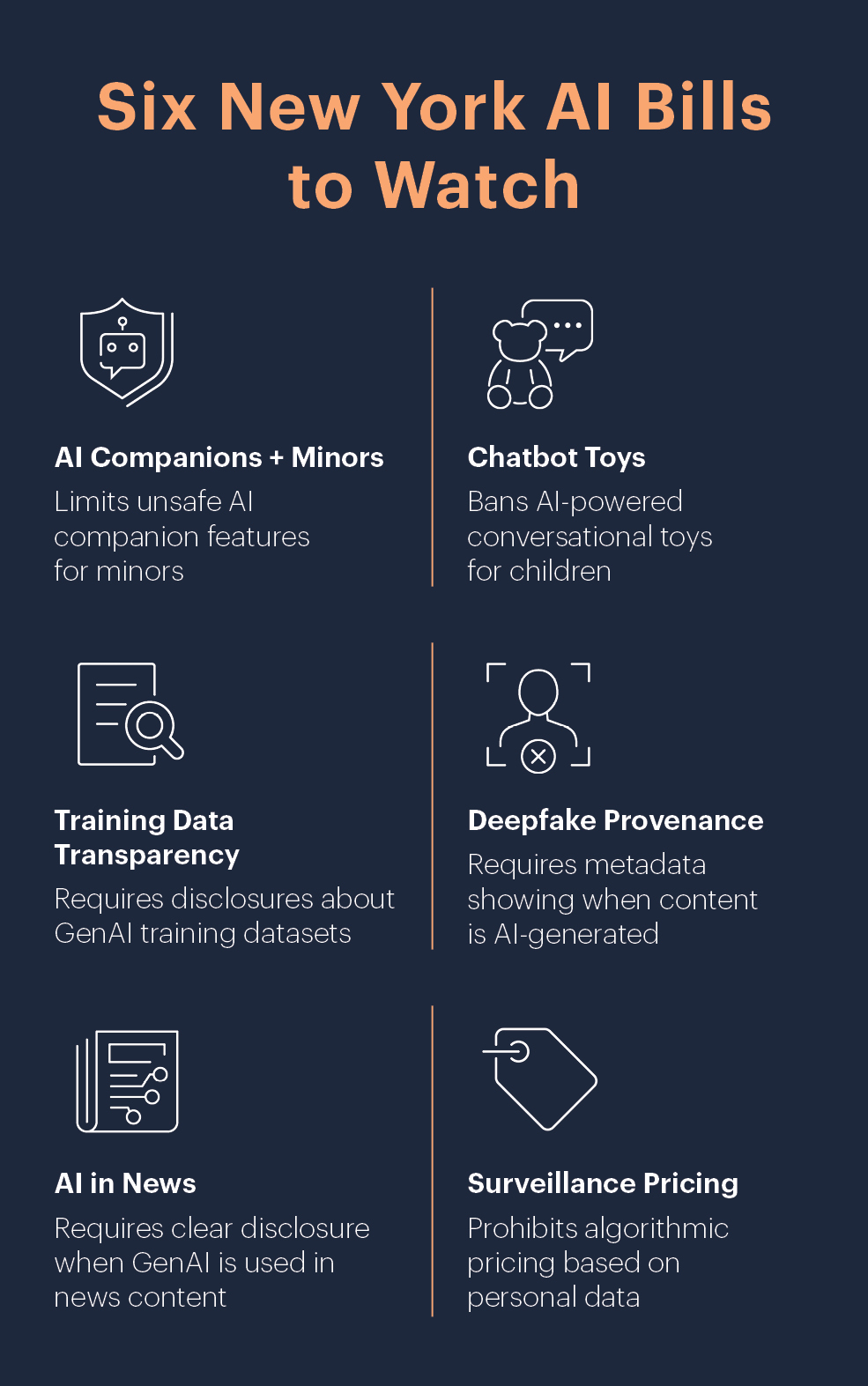
Artificial Intelligence Training Data Transparency Act (A6578B)
The Artificial Intelligence Training Data Transparency Act would require developers of generative AI (GenAI) models or services made available to New York users to disclose information about the datasets used to train those systems.
If enacted, developers would have to publish documentation on their websites describing, at a high level, the sources and characteristics of GenAI training datasets. Required disclosures would include the sources or owners of the data, the types of data points used, the approximate size of datasets, whether the data includes copyrighted material or personal information, whether the data was purchased or licensed, and whether synthetic data generation was used (or is continuously used) in GenAI development. Developers would also have to disclose when data was collected and when it was first used during GenAI development.
These disclosures would have to be posted before the GenAI model or service, or any substantial modification to it, is made publicly available to New Yorkers. Certain systems are exempt, including those used solely for aircraft operations, or for national security, military, or defense purposes. The act would take effect immediately upon the governor's signature.
This would bring New York closer to California, which has a GenAI training data transparency law.
Stop Deepfakes Act (S6954A)
The Stop Deepfakes Act would require providers of generative AI systems capable of producing synthetic audio or visual content to attach "provenance data" to AI-generated or AI-modified content. Provenance data is metadata that records the origin and history of digital content and indicates whether artificial intelligence was used in its creation or modification.
Under the bill, synthetic content creation systems would have to embed information identifying the content as AI-generated, the name of the system provider, the date and time the provenance data was applied, and the portions of the content generated by AI. Hosting platforms could not distribute AI systems that fail to include this provenance data or that intentionally prevent it from being applied to synthetic content.
The bill would also require social media platforms to preserve provenance data associated with uploaded content and prevent them from removing or degrading that information unless the content itself is deleted or legal obligations require removal. Violations would be enforced by the New York Attorney General, who could seek injunctions and civil penalties of up to $25,000 per violation. The law would take effect 180 days after enactment.
New York Fundamental Artificial Intelligence Requirements in News (FAIR News) Act (S8451B)
The FAIR News Act would impose transparency requirements for the use of generative artificial intelligence (GenAI) in news media. Any news content substantially created using GenAI that is published, broadcast, or otherwise distributed in New York must clearly disclose that GenAI was used. The disclosure would have to appear conspicuously at the beginning of the content, for example, at the top of written or visual content or verbally at the start of audio programming. Material eligible for copyright registration would not be subject to this disclosure requirement.
The New York Attorney General may enforce the law through court actions seeking injunctions and civil penalties. Violations carry penalties of $1,000 for a first offense and $5,000 for subsequent offenses. The law would take effect 60 days after enactment.
Prohibition on Surveillance Pricing (A9349B)
This bill would prohibit the use of "surveillance pricing," which is defined as algorithmic pricing that uses a consumer's personal data to offer different prices to different individuals for the same goods or services. The law would prohibit entities and service providers from setting prices using personal data, advertising such prices, or collecting or sharing personal data for the purpose of enabling surveillance pricing. However, it would preserve the use of traditional discounts, including broadly available promotional pricing, loyalty programs, and discounts based on limited criteria such as voluntary membership or prior purchase history, provided certain transparency conditions were met.
The New York Attorney General would enforce the law and seek injunctions, restitution for affected consumers, and civil penalties of up to $5,000 for a first violation and $20,000 for subsequent violations. The act would take effect 180 days after enactment.
The bill would amend New York's existing algorithmic pricing law, which faces legal challenges. Other states have already explored or passed laws on surveillance or "data-driven" pricing.
What's Next
The New York legislative session ended on June 5, 2026. These bills have not yet been delivered to the Governor, and the Governor's review period has not started. Once the bills are delivered, the Governor will have 30 days to sign or veto them, and failure to act within that period will result in a pocket veto, meaning the bills will not become law.
Legal challenges are possible, especially under the First Amendment. The chatbot regulations appear to restrict access to speech and information based on content, and specifically the impacts that content is expected to have on its audiences. The training data transparency law both compels speech and may effectuate a taking of trade secret information without just compensation (and indeed DWT currently represents an AI system challenging a similar law in California). The deepfake law burdens the creation of expression, compels speech, and constructs a system of formal and informal restraints limiting the dissemination of creative tools and their expressive outputs. The FAIR News Act enters newsrooms and compels editorial disclosures. And the surveillance pricing law bans certain commercial speech and burdens the dissemination of information for certain purposes. Heightened if not strict scrutiny arguably applies to all of these laws, which would be vulnerable to limitation or outright invalidation as applied to certain providers, if not altogether on their face.
Companies developing, deploying, or distributing AI systems, AI-generated content, algorithmic pricing tools, or related digital products should consider how these bills could affect their compliance obligations and litigation risk if enacted. Please contact your DWT team if you would like help evaluating potential exposure, preparing for compliance, or assessing possible grounds for challenge.
Contact: Bianca Tillman, David Rice, John Seiver, Adam Sieff, Ambika Kumar, and David Gossett
Back to top
President Trump Issues Two Executive Orders on Quantum Computing
President Trump recently signed two executive orders on quantum computing. Quantum computing is fundamentally different from ordinary computing: it leverages the unusual physics of subatomic particles to quickly perform certain calculations that would take current supercomputers thousands of years. Quantum computing offers the possibility of major scientific breakthroughs, acceleration of AI technology, and other massive benefits unachievable with current computers. But it also presents significant risks: a sufficiently advanced quantum computer could break the cryptographic algorithms that are essential to securing data and communications across the internet.
Executive Order 14412
The first executive order, "Securing the Nation Against Advanced Cryptographic Attacks," (Executive Order 14412) is focused on protecting the federal government and critical infrastructure from quantum computing's threats to cryptographic security systems. The order directs a federal government-wide transition to post-quantum cryptography (PQC), i.e., to cryptographic algorithms and methods designed to be resistant to attacks by quantum (as well as standard) computers. Federal agencies must transition all high-value systems to use PQC for key establishment (using cryptographically generated "keys" to securely exchange information) by 2030 and for digital signatures (using cryptographically generated "signatures" to confirm that communications are authentic and have not been altered) by 2031. The Department of Commerce must complete a migration pilot program by the end of 2027.
Executive Order 14412 also has implications for the private sector. The order directs all agencies that serve as Sector Risk Management Agencies for critical infrastructure sectors under the April 2024 National Security Memorandum on Critical Infrastructure Security and Resilience (National Security Memorandum/NSM 22) must work with CISA to assist critical infrastructure owners and operators in developing their own PQC migration plans. The order does not set any deadlines for private sector owners or operators. The order also calls for updates to the Federal Acquisition Regulation (FAR) to require covered federal contractors to comply with requirements from the National Institute of Standards and Technology (NIST) on PQC-compliant algorithms. Moreover, by March 2027, CISA and NIST must release public guidance on the minimum elements of a "cryptographic bill of materials"—an inventory of all cryptographic technologies in a system and including important information such as algorithms used and key length. Agencies may begin requiring their suppliers to maintain and provide copies of cryptographic bills of materials based on the CISA and NIST guidance.
Executive Order 14413
The second executive order, "Ushering in the Next Frontier of Quantum Innovation," (Executive Order 14413), calls for promotion of American superiority in quantum information science and technology (QIST). Among other things, the order establishes a Quantum Computer for Application Development and Discovery Science (QC-ADDS) Effort to pursue development of quantum computing at scale for quantum-enabled scientific discovery. The order also requires the heads of the Departments of War, Commerce, and Energy, the National Science Foundation (NSF) and the National Aeronautics and Space Administration (NASA) to develop plans for advancing quantum sensing (using quantum properties of subatomic particles to build ultra-precise instruments) and quantum networking (using quantum properties to develop ultra-secure quantum communications networks). The Secretary of Commerce is directed to develop plans for strengthening the nation's QIST supply chains, including by encouraging private-sector adoption of QIST-related standards. The Federal Bureau of Investigation (FBI) is charged with leading a multi-agency effort to improve and coordinate protections against cybersecurity threats to QIST. The Office of Personnel Management (OPM) is required to lead an effort to "build a strong national security quantum-workforce."
Contact: Michael T. Borgia and Andrew Lewis
Back to top
Court Allows ECPA Claim Premised on DOJ Bulk Data Rule Violation to Proceed
In our March issue, we described how class action plaintiffs were invoking alleged violations of the Department of Justice's (DOJ) so-called bulk data access rule to support wiretapping claims under the Electronic Communications Privacy Act (ECPA), even though DOJ's rule contains no private right of action. We discussed one case, Baker v. Index Exchange, Inc. (N.D. Ill.), as a leading example.
In the late June ruling, the Baker court denied the defendants' motion to dismiss, becoming the first court to hold that an alleged violation of the DOJ rule can trigger ECPA's crime-tort exception and overcome ECPA's "party exception" defense. Under ECPA, an interception of a communication is not unlawful if at least one party of the communication consented to the interception (the "party exception"). However, the party exception does not apply if the communication was intercepted for the purpose of committing a criminal or tortious act (the crime-tort exception).
In Baker, the plaintiff alleged that Index Exchange, a Canadian advertising platform, intercepted his web browsing communications when he visited BibleGateway.com (a website that participates in Index Exchange's ad sale process) and—through real-time bidding and cookie syncing—transmitted his personal data to Temu, a Chinese retailer. Plaintiff alleged that this activity constitutes a "data brokerage" transaction prohibited by the DOJ rule. The court held that the alleged violation of the DOJ rule constituted a tort in violation of federal law, and therefore that plaintiff sufficiently pleaded that ECPA's crime-tort exception overcame the party exception.
The decision confirms that exposure under the DOJ rule is not limited to DOJ enforcement. Companies that engage in broadly defined data brokerage under the DOJ rule, including those engage in cross-border third-party advertising, should assess their potential exposure to ECPA claims following the Baker decision. That said, important questions raised by defendants in Baker remain unresolved as the matter proceeds, including questions about whether Temu is a "covered person" under the rule, the rule's validity under the International Emergency Economic Powers Act (IEEPA), the scope of the rule's financial services exemption, the scope of key definitions, and whether alleged violations of the DOJ rule could also satisfy the criminal prong of ECPA's crime-tort exception.
Contact: Michael T. Borgia and John Seiver
Back to top
CISA Town Halls Point to Potentially Significant Changes to CIRCIA Notification Rules
We noted in our March issue that the Cybersecurity and Infrastructure Security Agency (CISA) had announced a series of virtual town halls to solicit more industry feedback on its forthcoming cybersecurity reporting rules. CISA's town halls were subsequently delayed due to the partial government shutdown affecting funding for the Department of Homeland Security (DHS), of which CISA is a part.
CISA finally held its rescheduled town halls in June. DWT attended those sessions and noted these recurring themes:
- Stakeholders were highly critical of CISA's proposed definition of "covered entities," particularly CISA's reliance on the Small Business Administration's (SBA) size thresholds. As discussed in a prior blog post, while many expected CISA's notification rules to apply only to specific types of critical infrastructure entities, CISA's proposed rules apply broadly to any entity in a critical infrastructure sector that meets one of many sector-specific criteria or that exceeds SBA thresholds. By CISA's own calculations, the proposed rules would apply to more than 316,000 entities.
- Various stakeholders also noted that CISA's proposed reporting requirements, which implement the Cyber Incident Reporting for Critical Infrastructure Act (CIRCIA), are at least partially duplicative of incident reporting requirements under various federal and state laws. Stakeholders advocated for CISA to leverage existing reporting requirements where appropriate to gather information about cybersecurity incidents without requiring covered entities to file additional reports with CISA on top of already-required reports.
- Stakeholders additionally raised concerns that the proposed definitions of reportable cyber incidents, reporting triggers, and content requirements may not align with real-world incident response practices. Commenters emphasized ambiguity between "substantial" cyber incidents referred to in the proposed rule and "significant" cyber incidents referred to in other laws, and encouraged limiting reporting to clearly defined substantial incidents.
CISA will now move to finalize its notification rules. According to CISA's regulatory plan published on July 3, 2026, CISA aims to finalize the rules by September 2026. CISA published its proposed rules in April 2024, with finalization originally expected by September 2025.
Contact: Michael T. Borgia, Andrew Lewis, and Ryan Burns
Back to top
Five Eyes to Corporate Leaders: Act Now to Address AI Cyber Risks
The leaders of cybersecurity agencies from the nations that make up the Five Eyes intelligence-sharing alliance—the United States, the United Kingdom, Australia, Canada, and New Zealand—issued a rare joint statement warning that frontier AI models are transforming both offensive and defensive cyber capabilities faster than organizations are adapting. The heads of the Cybersecurity and Infrastructure Security Agency (CISA) and the National Security Agency (NSA) joined signed for the United States.
The joint statement explains that AI is rapidly shrinking the window between the discovery of a software vulnerability and its exploitation, meaning that attackers often can exploit vulnerabilities to conduct cyberattacks before companies can patch those vulnerabilities. Notably, the statement is addressed not to security teams but to organizational leadership: it calls on executives and boards to assess AI-driven cyber risk directly, to give security leaders the authority and resources the threat environment demands, and to assume that breaches will occur and prepare to contain them. The prescriptions themselves are deliberately familiar (and reflect guidance from the New York Department of Financial Services and other authorities, which we discussed in a recent blog post), including to reduce attack surface and unnecessary connectivity, to accelerate patching timelines, to retire unsupported legacy systems, to tighten identity and access controls, and to use AI to detect vulnerabilities earlier, monitor unusual behavior, respond faster to incidents, and strengthen defenses.
Contact: Michael T. Borgia and Andrew Lewis
Back to top
FCC's Breach Reporting Rules: Updates on Ohio Telecom Ass'n v. FCC
As we discussed in a prior blog post, the Sixth Circuit's 2025 decision in Ohio Telecom Ass'n v. FCC upheld the 2023 data-breach reporting rules for telecommunications carriers issued by the Federal Communications Commission (FCC). Although the court rejected the FCC's argument that it was permitted to issue the breach reporting rules under section 222(a) of the Communications Act, it agreed with the FCC that the breach reporting rules were properly issued under section 201(b). The court adopted an expansive interpretation of Section 201(b) to permit the FCC to regulate "unjust or unreasonable" practices, including failures to notify customers and the FCC of breaches involving personally identifiable information (PII). The court further held that the Congressional Review Act (CRA) did not bar the FCC from issuing its breach reporting rules, even though Congress had invoked the CRA to reject similar breach reporting rules previously issued by the FCC.
Following the decision, petitioners sought rehearing en banc of the Section 201(b) and CRA holdings, urging the court to apply the CRA to all parts of the disapproved rules and to narrow the scope of Section 201(b). On October 7, 2025, the Sixth Circuit granted the FCC's request to hold the case in abeyance while the agency "evaluates the underlying rule," requiring status updates every 60 days. In successive filings through June 16, 2026, the FCC confirmed that its review remains ongoing, but that it would not finish the review by the court's deadline of June 17. In response to the FCC's earlier status report, the court directed the FCC to respond to the en banc rehearing petition by July 2 if the FCC's review was not completed by June 17.
On July 2, 2026, the government filed its response opposing rehearing en banc. The government argues that no circuit split exists on either the Section 201(b) or CRA questions and characterizes the decision as "narrow" and of "limited significance" concerning whether the FCC may require breach reporting for PII rather than only customer proprietary network information (CPNI), rejecting petitioners' contention that the ruling confers sweeping new regulatory authority on the Commission. With the abeyance ending and the rehearing petitions now fully briefed, the panel decision remains in place while the court considers whether further en banc review is warranted while the FCC continues evaluating the underlying rule. Notably, although the FCC has not yet indicated whether it ultimately intends to retain, revise, or rescind the rule and is continuing to defend the Sixth Circuit's decision.
Petitioners replied to the FCC's opposition on July 6, 2026, arguing that the FCC failed to substantively defend either the panel's CRA analysis or its interpretation of Section 201(b). Petitioners renewed their contention that the decision weakens Congress's ability to use the CRA to prevent reissuance of disapproved rules and grants the FCC expansive authority over carrier practices beyond traditional communications regulation and the text of Section 201(b). They further noted that the FCC is already invoking the decision's expansive reasoning to regulate any carrier activity it can plausibly characterize as a "practice" within Section 201(b), citing a recent FCC notice of proposed rulemaking claiming authority to regulate where carriers can locate their call centers and even what language their employees can speak.
Contact: Michael T. Borgia, John Seiver, and Soraya Mohammed